Thursday, February 2, 2012

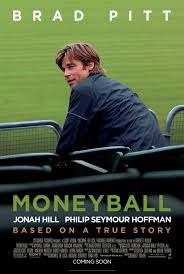
Moneyball (2011), Film 1/50

Warning: The following post contains spoilers. I didn't give away the climax of the film, but you'll definitely leave knowing more than you did coming in. Also, if you haven't seen the movie you may be confused by some of the references and/or so-called jokes made throughout. But then there's a good chance people who've seen the movie won't know what the hell I'm talking about either. Enjoy.
You know why I don't like karaoke? The song selection. They never have the right songs. And by "right," I mean songs that I consider to be in my wheelhouse (for the purposes of this intro, let's assume that I do, in fact, have a wheelhouse, even though, in reality, I of course do not). I've attended many a karaoke night, scouring the big, weathered song binders for songs that are up my alley. Wilco's Shot in the Arm. Pearl Jam's Footsteps. Anything off of Pinkerton. But alas, I always come up empty. The stuff they do have? It's sadly nothing in my skill range (again, assuming there is some subset of songs out there that actually falls within my vocal capacities...which, again, there is not). I am simply not versatile enough to pull off any of the songs they have at most karaoke nights.

This is not a problem which I imagine Aaron Sorkin has. If I were compelled to picture Mr. Sorkin at a karaoke bar (and I apparently am so compelled), I imagine him as a confident, tie-loosened individual who gets up there and belts out everything from Sinatra to Bon Jovi to Adele to Kid Rock (note: I would pay good money to see Aaron Sorkin belt out Kid Rock). The guy can do it all. A Few Good Men, The American President, The West Wing, those are all well and good. Solid crowd pleasers that other people in the bar might be able to pull off (though not nearly as well). But then the dude breaks out a song about Facebook--the karaoke equivalent of reading the phone book--and he still blows the doors off the place. He follows that up with a little diddy about a baseball general manager and his chorus of stat geeks with economics degrees from Yale. And everyone loves that too! The guy has no limitations. I can't wait to see his next flick about a guy sitting on his couch staring at the wall, which is sure to become a riveting, heart-wrenching, movie of the year contender.

But enough about Wall Starer (The Men Who Stare at Walls? They're still workshoping.). Today we're talking about Moneyball, which if you can't tell from the last paragraph-worth of praise and flimsy metaphor, I liked a great deal. Could they have dealt a little more with the ambiguous nature of Billy Beane's success--the possibility that just maybe the A's were good at least in part because they had three of the best pitchers in baseball? Probably. Could they have somehow given us a look at Beane and the A's war room during an MLB draft (one of my favorite parts of the Michael Lewis book)? Potentially. But at the end of the day, these are minor quibbles. What Sorkin and friends give us is not meant to be a faithful rendition of their source material, or a defense of sabermetrics. It's a story about one man--Billy Beane--and the not at all lofty goal he sets for himself to change the game of baseball.

As if to reinforce this idea, the style of the film mirrors that of it's main character. Beane keeps the game at arms length and, for the most part, so does the movie. If you add up all the scenes of "live" Oakland A's baseball, you probably get about two and a half minutes worth of film (Hatteberg trying to field a grounder at first, Jeremy Giambi misjudging a fly ball in the outfield, and brief glimpses of an A's Royals game in September). The rest is presented through radio broadcasts, text messages, and tv footage (which, by the way, makes the A's Royals game they do highlight stand out all the more...nice touch there). What's more the portrayl is consistent with a core belief of sabermetrics; namely, that games are won and lost in the front office. The field is simply where all the various precalculated percentage receptacles put on uniforms and go play themselves out (as Pitt opines at one point, How can you not be romantic about baseball?).

As far as the receptacles (aka players) go, Chris Pratt and Stephen Bishop get some nice moments as Scott Hatteberg and David Justice (Pratt especially does a nice job playing dumbfounded during the scene in his living room, a talent he has no doubt honed during his time on Parks and Rec). But for the most part, the film is driven by two relationships: Billy Beane & Jonah Hill (Hill does a great job, but I can't remember the fake name they came up with to replace Paul DePodesta so let's just call his character Stat Guy), and Billy Beane & his daughter. Without the former, there is no movie; without the latter, I wouldn't still have that damn catchy Lenka song in my head a week after the fact.

The film does a nice job of portraying the Beane/Stat Guy dynamic as a partnership. Stat Guy might know more about the numbers, but there's never a sense that he's leading Beane around by the nose. For one thing, Beane doesn't always take Stat Guy's advice (i.e. Jeremy Giambi). For another, Stat Guy has a lot to learn when it comes to telling players they've been traded (from what I gather, you basically dump the whole mess on the team's traveling secretary and move on). And finally, Beane can teach Stat Guy some things about dealing with other general managers, as exemplified by the GM's masterful orchestration of a trade late in the movie (for any Sorkin fans out there, this scene was basically a series of walk and talks minus the walk, but with more telephones. Perhaps from now on we refer to this as a cell and tell? Yes? Wait, don't leave yet. Keep reading. I promise it's almost over.).

But for all the Billy Beane/Stat Guy buddy banter, it's Beane's daughter who gets the last word. Her song, besides being too adorable for words, is a ticking time bomb. Aaron "Cowboy Kid Rock" Sorkin arms it during the daughter's first jaw-dropping scene in the music store, and then he detonates it in the film's final frames to make sure nobody is leaving that theater bummed out by the otherwise somber ending. It's a manipulative, wonderfully effective maneuver that works in most part due to the choice of song. Lenka's The Show sounds as if it were engineered in a laboratory for the sole purpose of ending melancholy movies on a happy note. With a song that upbeat, the writers could've gotten away with damn near anything in the second to last scene. Billy Beane could've gone after Art Howe with a chainsaw (and really, who could blame him?). He could've packed Art's body into his Jeep, driven it out to the desert and buried it all the while mumbling "Hatteberg, not Pena. Hatteberg...not Pena." But as long as Brad Pitt gets back in his car, puts on his daughter's cd and starts driving, everyone in the theater heads home with a warm fuzzy feeling in their bellies. And that, my friends, is the magic of Aaron Sorkin (or whoever wrote the ending. I don't know. The movie had a lot of writers. Could've been one of the other ones. Sorkin can't write everything. He's got karaoke bars to get to.).

Rating: 8/10 Monocles


Pretzel Most Likely To Be Endorsed By Stat Guy: Snyder's Snaps. Let's face it, Stat Guy has trouble fitting in. He doesn't like 5-tool prospects. He is unable to wax creepily about the bodies of young high school boys like all the other scouts. It would be a sad cry for help if he were to start sucking down sunflower seeds just like everybody else. Stat Guy needs his own snack. Something that tells people, I too can exhibit a debilitating oral fixation while acquiring high levels of sodium, but on my own terms. Well Stat Guy, say hello to Snyder's Snaps. Geometrically sound, each pretzel looks like a miniature strike zone, just like the one you use to plot the pitches hitters see during their at bats! It's the perfect way to fill your belly while simultaneously sticking it to every Joe Morgan-loving yahoo of a scout who refuses to wake up and join the 21st century. Also, they taste great with sour cream!

Sunday, January 29, 2012

Shaq Uncut (2011), Book 1/50

The 2011 NBA strike left a trail of pain and destruction in its wake. Team employees lost their jobs. Players lost their paychecks. China lost out on the joy of not living in the same country as J.R. Smith. And I, in a misguided moment of NBA withdrawal, lost a piece of my dignity when I cracked the spine on a little book called Shaq Uncut.

It was Christmas morning when I first started learning about the life and times of a young Wilt Chamberneezy (one of nine Shaq nicknames helpfully proffered by the inside flap of the book jacket. Are we going to work our way through the other eight? You bet your sweet Mike Bibby.). By bedtime the NBA season was four games old, and I had twelve hours of hard-watched opening day basketball under my belt. (It was my first Christmas with the new in-laws by the way. I'm sure they were all very impressed.) Suddenly, I didn't need to get my basketball fix by reading from Superman's (nickname #2) diary. I had live games to watch. Fresh commentary to read and listen to. My basketball battery was charged, and as I drifted off to sleep that night, the Big Shaqtus (3) and his eerily four right-angled goatee were but a fading memory in my mind.


And yet, the book lingered. Maybe it was laziness. Maybe it was the fact that we had a long plane ride home and there was no way I was prepared, mentally or physically, to delve into the 800-plus page Stephen King hardcover behemoth, 11/22/63 that I had also received for Christmas. (I am in no way a fan of the Kindle or the Nook, but for hardcover books with 500 or more pages, Technology, I can kinda see your point).


Whatever the reason, I pressed on. And actually, The Big Daddy's (4) memoir isn't that bad. I'm not sure how much Jackie MacMullan had to do with it, but The Big Aristotle (5) spins a fairly consistent, well-structured yarn. The stuff about his early years is interesting. Especially the fact that he was basically being groomed from a very early age (at least in hindsight) to be a professional basketball player. Whenever parents, step-parents, or grandparents doled out discipline or chased away bad influences, the reasoning inevitably circled back around to this is going to get in the way of basketball.


The book also had the requisite number of words devoted to Shaq Fu's (6) opinons of the various coaches and players he came into contact with during his playing days. These descriptions were alternately complimentary (Dwayne Wade, the C's big 3 & Rondo), illuminating (Phil Jackson & Pat Riley), reaffirming (Jerry West), and conflicted (Kobe). Nothing mean-spirited, but still candid and basically sincere. Shaq strikes me as a legitimate team player (taking less money so other talented players could be signed, offering his home gym as a practice facility) while at the same time, he doesn't appear to be what anyone would refer to as low maintenance. Whether it was hanging out in clubs until after curfew, lobbying for less practice time (so his body could recover), or operating with more body fat than his training regimen allowed, The Big Shamrock (7) was not a go with the flow type presence.


But what struck me most about Shaq wasn't the basketball stuff, it was the non-basketball: the music career, the movies, the tv shows. He seemed to be so proud of it all, and it all seemed to be so thoroughly mediocre. Whether he was recording a compilation album with other, more legitimate rappers, or shooting Kazaam, it seemed like, away from the court, Shaq simply followed the path of least resistance. He tried to do as much as he could simply for the sake of doing it, quality and craft be damned. (The exception that proves the rule: The Real Deal's (8) involvement with the vastly underrated Blue Chips, in which he plays a young, altruistic, even-gets-along-well-with-kindergarteners basketball player named Neon Budroe. (Not sure if I have the right spelling for Budroe. Imdb lists him only as "Neon." Hey internet movie database, you and I both know that character had a last name. Do your job.) Shaq's actually kinda halfway decent in his acting (read: he doesn't ruin the movie), and the picture itself holds up better than expected. That last press conference with Nick Nolte--the He's got the best players money can buy! speech has to be right up there with Al Pacino's the inches we need are all around us locker room pep talk from Any Given Sunday. By the way, did we really just go two parenthesis deep twice within the same parenthesis break? Yikes. I'll try to scale it back as we close this thing out.)


Possibly the best example of Shaq's shortcut compulsion was his reality show, Shaq Vs., in which Shaq was literally given shortcuts each week in competing with athletes from other sports. So if, say, Michael Phelps had to make it to the other end of the pool and back, Shaq would only have to make it to the other end. And if Shaq won? Well, I don't know exactly what that would prove. Maybe that Shaq was half the swimmer Phelps was? Way to go there, Diesel (9).


Of course another way to look at all this is to say that Shaq used his fame and notoriety to try out as many different things as he possibly could. And it's kinda hard to fault him for that. It cannot be denied that the guy has lived a full life. When you have conductor of the Boston Pops, Olympic gold medal winner, and honorary U.S. Deputy Marshall on your resume, it's hard to argue that you haven't been carpe dieming it up all over the place. Is that worth potentially sacrificing the chance to be one of the three best basketball players ever? Maybe. Probably? I honestly have no idea.


Rating: 4/10 Monocles


The Pretzel Shaq Most Resembles: The Pretzel M&M. Slightly gimmicky. Not quite as much thought put into the pretzel as you would like (too much dough, they should've used something more like a Pretzel Crisp). Tasty overall, but mostly because it's still an M&M and M&M's are delicious. Ultimately feels like there's something missing; vaguely unsatisfying no matter how many you eat.

Thursday, January 26, 2012

Fifty Fifty Challenge


Here at pretzel gentleman, if we had to rank how often we do each of the following

Eat Pretzels
Watch Movies
Read Books

it would look like this:
1. Eat Pretzels
2. Watch Movies
3. Read Books

And to be honest, it isn't even close.

While it is unlikely that pretzels will ever relinquish their top spot in the pecking order, this challenge is an attempt to at least make it a contest for second. Fifty movies and fifty books in 2012. "But pretzel gentleman," you say, "what if I don't like books or movies. Or what if, like most Americans, I have always held a certain curiosity with regard to 'reading' and 'watching films,' but have never found a suitable way into these worlds, as opposed to, say, the joy and passion I feel for consuming and ranking the seemingly endless array of pretzels and pretzel-based treats that this world has to offer. What then, pretzel guy? What does this site have for me?"

Well, first of all, it's pretzel gentleman. This is a classy website, not some middle-aged oaf with askew facial hair standing on a street corner waiting for Shakes to come by and lure him away so teenage-version Brad Pitt can steal his precious pretzel cart to go off and kill some old lady on the subway. (Yes, I know it was a hot dog stand, but come on, close enough. Also, this being in part a movie review blog, I feel compelled to point out that that was a movie reference. If you haven't seen Sleepers, you should go watch it immediately. Also, spoiler alert.)

Second of all, lots. In addition to posting movie and book reviews, I'll be letting you know either what kind of pretzel the book or movie most resembles, or what salty treat said cultural artifact would best be paired with (kinda like wine...classy, no?). What's more, I'll be ranking each entry on a scale of 1-10 monocles (graphic possibly coming soon!) with the most deserving books and movies moving on to compete for the coveted Golden Top Hat, an award so profound and enigmatic that it defies a simple one sentence explanation. (Basically the best movie and book of the year. Eh, look at that.)

So buckle up! It should be a fun ride, or at least one that is not entirely tedious and bland. Of course there's always a chance that I could lose interest in this blog and abandon the project entirely sometime around March, and then you will have invested all this time for nothing. What a shame. Enjoy!